
Player signup
Confirm the South African ID and check the selfie capture before applying the normal activation rules.
1SA ID verification
2Passive Liveness
Player verification for iGaming can stay simple. Verify identity at signup, check Passive Liveness from one selfie, then step up bank validation only when a defined payout rule requires it. Add AML/PEP or selfie-to-Home-Affairs-photo Face Match only when the relevant RMCP or identity-risk trigger requires it.
iGaming verification
Onboard players quickly and protect every payout.
Combine SA ID, age, face, liveness, bank and AML checks in a player journey built for online betting.
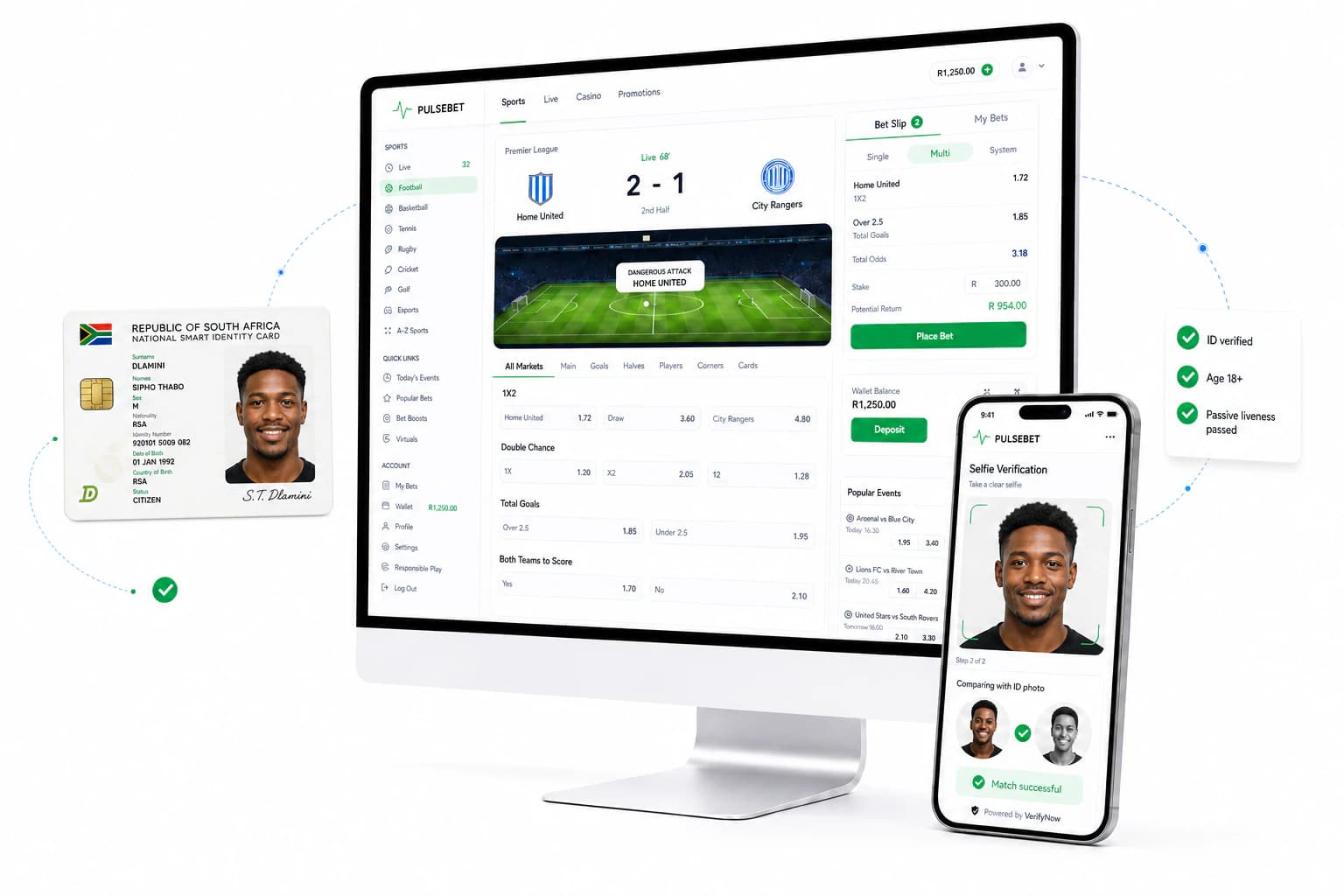
Choose the journey that fits: enter an SA ID, photograph and authenticate an ID document, or use one selfie for Passive Liveness. Fetch the Home Affairs photo and run Face Match only when stronger identity binding is required.
Basic uses an SA ID and one Passive Liveness selfie. Document and official Home Affairs photo comparisons stay optional. Only the selected blocks run.
PULSEBET
Sportsbook
Cash balance
R250.00
Manchester United
Score
1:1
Liverpool
Match result
42 markets ›
Bet slip · 1
Stake R50.00
Possible return
R105.00
Verify before placing this bet
Confirm your age and identity without leaving PULSEBET.
Verification progress
What is happening now
Waiting for the player
The player stays inside PULSEBET and starts verification when they are ready.
Selected checks
SA ID and age
Confirm the player’s ID details and 18+ status.
Passive Liveness
Check one selfie for live-presence signals without a movement challenge.
Decision returned
Send the result back to the PULSEBET player journey.
A practical online betting flow uses SA ID Verification and Passive Liveness as Basic, then calls bank validation, AML/PEP or Home Affairs photo Face Match only when its trigger fires.
Choose individual checks and place them where they fit your signup, account review or payout journey. A common flow starts with SA ID and date-of-birth verification. One selfie then runs Passive Liveness as the second Basic check. Age Estimation can be added as a separate triage signal, but the verified ID date of birth remains the 18+ evidence.
Bank validation is a separate step-up check, not an automatic part of the onboarding bundle. Call it before the first payout, after a payout-account change or when a withdrawal triggers review. AML/PEP, document authentication and Home Affairs photo Face Match remain optional blocks that run only when the operator's documented rule requires them.
Each verification works on its own. Combine only the checks required for that point in the player lifecycle.
Confirm basic identity details and date of birth for an 18+ account-opening decision.
Explore serviceCheck one selfie for passive liveness without requiring a blink, head turn or movement challenge.
Explore serviceFetch the supported Home Affairs identity photo and compare it with the selfie only when stronger identity binding is required.
Explore serviceStep up before payout to compare the nominated account-holder details with the verified player.
Explore serviceScreen a player when your RMCP or risk rules require an AML, PEP or sanctions check.
Explore serviceAuthenticate a passport or foreign identity document where an SA ID check is not suitable.
Explore serviceNeed optional age triage as well? The Age Estimation API returns age-estimation and passive-liveness context from the same selfie. The same call returns both results and charges once.
Start small and add another verification block only when your operational or risk rules call for it.
Confirm the South African ID and check the selfie capture before applying the normal activation rules.
Add the nominated payout account only when the first payout, an account change or another defined event requires it.
Run AML/PEP or compare the selfie with the Home Affairs photo only when the RMCP or identity-risk rule requires it.
Syndicates exploit gaps between signup, account use and payout. Identity and biometric checks help at onboarding; bank validation creates another control point before money leaves the platform.
Read the 2026 iGaming industry reportVerify SA ID details and review duplicate-onboarding signals before allowing another account to use the same identity.
Use Passive Liveness for the Basic capture check. Fetch the Home Affairs photo and run Face Match only when the selfie must be tied to the official identity record.
Step up to bank validation at first payout, after a payout-account change or when a withdrawal triggers review.
These checks return identity and payout evidence for syndicate-risk review. Combine them with device, contact, IP, payment, promotion and wagering monitoring, plus manual review of linked accounts.
South African gambling is regulated by the National Gambling Board (NGB) at national level and by provincial gambling boards that issue the actual operating licences. Licensed gambling operators fall within FICA Schedule 1 supervision. That places them inside the standard FICA framework: RMCP, CDD, EDD, record-keeping and reporting.
The National Gambling Act enforces the 18+ minimum age for all gambling activity. The Home Affairs SA ID number carries the date of birth in its first six digits (YYMMDD), so a successful Home Affairs verification lets the operator derive age with source-of-truth confidence. Where stronger age signal is useful, the operator can estimate age and receive passive-liveness context from one selfie. The Basic path can use the standalone Passive Liveness result. Fetch the Home Affairs photograph and run Face Match only when a defined identity-risk rule requires stronger binding. Responsible-gambling obligations (self-exclusion, problem-gambling measures) are handled through the relevant provincial body, not through VerifyNow.
The operator must document the POPIA basis, notices and safeguards for each check. It remains the responsible party and the FICA accountable institution; VerifyNow returns results and audit identifiers that can support the operator's records.
Use this path for player onboarding, age checks, withdrawals, high-risk reviews and ongoing monitoring.
iGaming workflows need strong age, identity, AML, POPIA and withdrawal controls.
If your organisation is an accountable institution, or your RMCP calls for a customer-book review, Batch AML lets you upload 10 to 1,000 people or entities and keep one consolidated result file. It is an optional workflow based on your duties and risk controls, not a requirement for every business in this industry.
Educational guidance only. Your accountable-institution status, RMCP, customer risk rating and lawful basis determine the final checks and records you must keep.
Yes. The gambling sector is supervised under FICA Schedule 1. Licensed gambling operators must register with the FIC where applicable, run a Risk Management & Compliance Programme (RMCP), perform customer due diligence on players, keep records and submit cash-threshold or suspicious transaction reports where required. VerifyNow supports a Basic SA ID and Passive Liveness path, with Bank Account Verification, AML/PEP and Home Affairs photo Face Match available as risk-triggered step-ups.
Age is encoded in the South African ID number itself (the first six digits are YYMMDD). VerifyNow's SA ID verification confirms the ID number and returns the date of birth, allowing the operator to enforce its 18+ rule. Passive Liveness checks the Basic selfie capture. Age Estimation can add a triage signal, but the estimate is not proof of age. Fetch the Home Affairs photo and run Face Match only when a defined risk rule requires stronger identity binding.
Age Estimation can be used as an early, low-friction triage step before full KYC. One selfie returns an age estimate together with a passive-liveness method and score. It does not trigger a second standalone liveness request or charge. Borderline or non-approved results should move to review or an ID-backed step. The estimate is not a replacement for the official 18+ proof required by a licensed gambling operator.
Use SA ID Verification plus Passive Liveness as the Basic path. Add Bank Account Verification for a defined payout event, AML/PEP when the RMCP or player-risk rule requires it, and Home Affairs photo Face Match when stronger identity binding is needed. This sequence avoids sending every iGaming player through every verification check.
VerifyNow's AML/PEP/sanctions screening checks supported domestic and international PEP and sanctions sources. Operators run a point-in-time screen at account opening and repeat it at the cadence set by their RMCP. Potential matches go to the MLRO or appointed reviewer, while each completed check retains its screening reference.
Use Bank Account Verification as a step-up check before the first payout, after a payout-account change or when a withdrawal presents higher risk. VerifyNow's AVS result checks the submitted account and account-holder details against the verified player details. A mismatch can be held for review before funds leave the platform, making third-party or mule-controlled payout routing harder to hide.
No single check can identify or stop a betting syndicate. Basic SA ID verification and Passive Liveness, plus risk-triggered Home Affairs photo Face Match, AML/PEP and bank validation, can make identity reuse, remote impersonation and third-party payouts easier to surface. Operators should combine these results with device, contact, IP, payment, bonus and wagering signals, then investigate linked accounts under a documented review process.
All player verifications run under explicit POPIA-compliant consent. You choose whether to collect consent through your own front-end and pass the artefact into the VerifyNow API, or use VerifyNow's built-in consent collection flow. Only the data required for each specific check is processed, purpose-limited to your CDD and AML obligations, and the audit log ties every verification to a consent reference. You remain the responsible party under POPIA.
Verify identity at signup, assess Passive Liveness from one selfie and add bank validation, AML/PEP or Home Affairs photo Face Match only when its documented trigger requires it.