
Onboarding KYC
Confirm an applicant exists, is not deceased and can be located before extending credit, a service or a wallet.
Resolve a South African ID to available address, contact and employer records for a documented fraud-detection or fraud-prevention workflow. Your business must confirm its lawful processing basis and authority before running the trace.
Background check South Africa
Know who you’re dealing with.
Check a South African ID number and bring available identity details, addresses, phone numbers and employer records into one clear report.
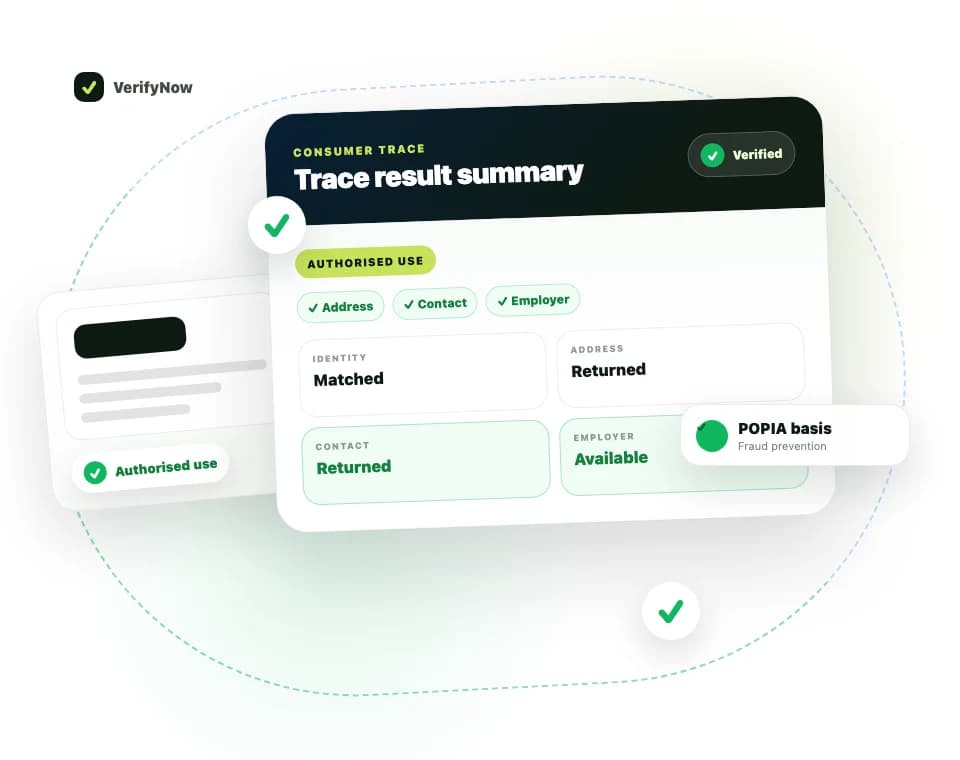
This service is restricted to documented fraud detection and fraud prevention workflows. Regulation 18(4)(b) of the National Credit Act (2005) and Section 11(1)(f) of the Protection of Personal Information Act (POPIA) may be relevant to your assessment, depending on your role and the facts. Your business must record its lawful basis, authority, necessity, access controls and retention. Data-subject objections under Section 11(3) of POPIA must be handled within your process.
One South African ID number brings available identity, address, phone and employer records into a clear report your team can review in minutes.
Run a Person Trace reportSample Person Trace
Background check report
Identity details
Name, ID, birth date and status fields
Address records
Available physical and postal addresses
Phone numbers
Available mobile and landline records
Employer information
Available employer and occupation records
One report. The available records your team needs to verify details and move the review forward.
Submit a South African ID number and receive a structured response with the fields below. Array fields contain zero or more records depending on what the official data sources hold.
ID numberFull nameInitialsTitleGenderDate of birthMarital statusDeceased flagConsumer IDAddress typeAddress linePostal codeNumber typeNumberEmployer nameOccupationTransaction referenceEnvironmentTimestampLoading sample report
Every scenario below is a permitted fraud detection / fraud prevention application.
Confirm an applicant exists, is not deceased and can be located before extending credit, a service or a wallet.
Investigate suspicious transactions by resolving an SA ID to current address, contact numbers and employer.
Corroborate declared employer and address information during hiring to prevent payroll and insider fraud.
Locate a customer whose last known address no longer reaches them so you can re-verify them for ongoing service.
Verify claimant identity and residence during suspected-fraud claim reviews under your fraud-prevention programme.
Quickly cross-reference identity fields when a customer reports impersonation or account-takeover fraud.
Check a South African ID number and bring available identity details, addresses, phone numbers and employer records into one clear report. Verify the information you received, spot mismatches early and make faster decisions.
Run a Person Trace reportCheck available names, date of birth, gender, marital status and deceased status linked to the ID number.
Bring available physical and postal address records into the same report.
See available mobile and landline records linked to the South African ID number.
Add available employer and occupation information to your review.
Under 10 seconds via the dashboard.
Normalised JSON — identity, addresses, contacts and employers.
Every lookup is logged with a fraud-prevention attestation record.
Integrate into your onboarding, fraud-ops or investigation workflow.
Licensed South African data sources and their source records support the report. The result records the returned fields. Your business must establish its lawful basis under NCA Regulation 18(4)(b), POPIA Section 11(1)(f), or another applicable provision.
Consumer/Person Trace is restricted to documented fraud detection and fraud prevention workflows. Regulation 18(4)(b) of the National Credit Act (2005) and Section 11(1)(f) of the Protection of Personal Information Act (POPIA) may be relevant to your assessment. Your business must confirm its lawful basis, authority, necessity and safeguards before running the trace.
Fraud detection and fraud prevention only. Typical use cases include onboarding KYC, payment-fraud verification, returned-mail address updates, employment screening for fraud exposure, insurance-claim fraud investigation, and identity-theft response. Any other use is prohibited by our terms.
Identity fields (ID number, full name, initials, title, gender, date of birth, marital status, deceased status, consumer ID), recorded addresses (type, address line, postal code), recorded contact numbers (type, number) and recorded employers (name, occupation). Every response includes a transaction ID and metadata block (environment, timestamp). Data is sourced from licensed South African data sources and their source records.
Results are returned through the VerifyNow dashboard when the source lookup completes. The same workflow is available to teams in Johannesburg, Cape Town, Durban, Pretoria and elsewhere in South Africa.
Data subjects retain the right to object on reasonable grounds under Section 11(3) of POPIA. If you receive such an objection you must stop processing and inform VerifyNow so the lookup record can be flagged. Section 18 of POPIA also governs notifications to data subjects about purpose and legal basis where feasible.
The report uses licensed South African data sources and their source records. The result identifies the fields returned for the stated fraud-prevention or fraud-detection purpose. Your business must establish its lawful processing basis under NCA Regulation 18(4)(b), POPIA Section 11(1)(f), or another applicable provision.
Yes. Records cover individuals across all provinces, including Gauteng (Johannesburg, Pretoria), the Western Cape (Cape Town), KwaZulu-Natal (Durban), the Eastern Cape, Free State, Limpopo, Mpumalanga, North West and the Northern Cape.
Create a free account and run your first Consumer/Person Trace in minutes.