
Confirm the real account holder
Check that the name and ID on the account match the person or company that handed you the bank details.
Before you release a salary, supplier payment, refund or loan disbursement, run a real-time check with the account holder's bank. Review mismatches linked to invoice-redirection, payroll-switch and refund fraud patterns in your dashboard.
Bank account verification
Release payments with confidence.
Check whether supplied South African bank details match the account holder before a payout, refund, payroll run or account change moves money.
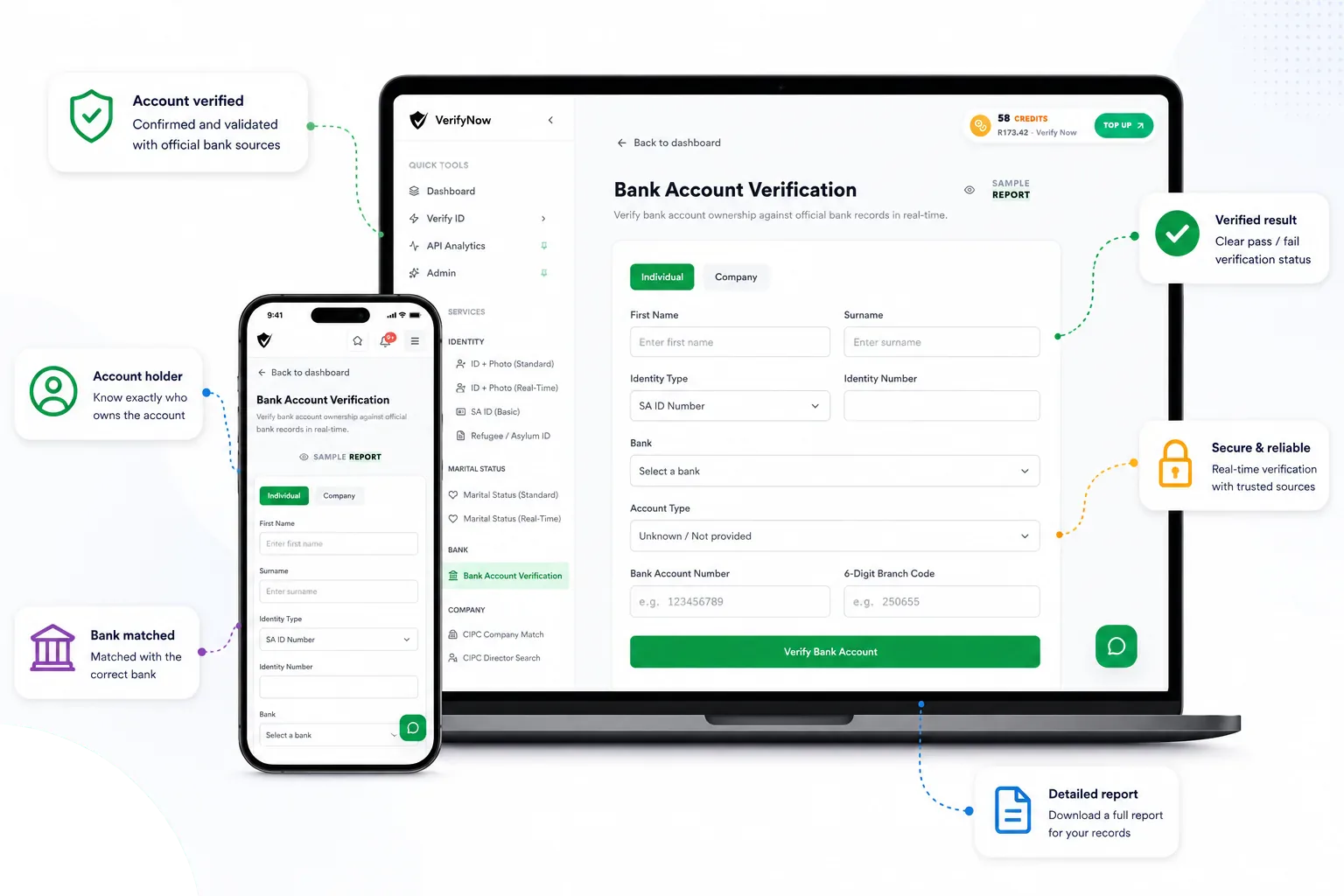
You stay in the VerifyNow dashboard the whole time. We talk to the bank on your behalf and come back with a plain-English result.
Account number, branch, account type, and the name + ID (or company registration number) of the person or business the account should belong to.
In real time, the account holder's own bank confirms whether the details you have match what they have on record.
Review the returned matches and mismatches, then apply your payment approval process. Each check is logged in VerifyNow.
Loading sample report
Operations, finance, HR and compliance teams across South Africa run these checks every day to stop the fraud that actually hits their business.
Check that the name and ID on the account match the person or company that handed you the bank details.
Each check leaves a result record that can support customer due diligence and internal review.
Real-time bank-side lookup. You don't leave the screen and neither does your customer.
Absa, Access, African Bank, Bidvest, Capitec, Discovery, FNB, Grindrod, GoTyme, Investec, Nedbank, Sasfin, Standard Bank and Bank Zero.
Matching fields can reveal bank-detail changes linked to invoice, payroll, refund and identity fraud patterns.
Straight from your VerifyNow dashboard. If your team later wants to automate, an API is available — but it's optional, not required.
These common payment-fraud patterns can surface as mismatches during a pre-payment bank-account check.
Criminals intercept an invoice and change the bank details on it. The supplier name looks familiar. You pay — into the criminal’s account.
Verify that the bank account really belongs to the supplier before every payment.
Fake employees added to payroll, or real employees' bank details quietly changed to an account the criminal controls.
Verify every employee's bank account before each payroll run.
A "customer" asks for a refund but to a different bank account from the one that paid you — and that account belongs to them, not the original buyer.
Confirm account ownership against the original buyer before you refund anyone.
A stolen ID used to open an account — or to claim ownership of someone else's account — so payouts get redirected.
Check the bank account against a verified ID number, not just a name.
Works for individuals and companies, across current, savings, transmission, bond and subscription-share accounts.
 Absa Bank
 Access Bank
 African Bank
 Bidvest Bank
 Capitec Bank
 Discovery Bank
 First National Bank (FNB)
 Grindrod Bank
 GoTyme Bank
 Investec Bank
 Nedbank
 Sasfin Bank
 Standard Bank
 Bank Zero
Real-world scenarios where a 10-second check saves five- or six-figure losses.
Verify supplier bank details before every invoice run. Stops invoice-redirection fraud before the money leaves.
Confirm employee accounts on onboarding and again whenever an employee requests a change to their banking details.
Validate the claimant's account before the payout to stop refund redirection and fraudulent claimants.
Confirm trust-account and beneficiary details on every transfer — the payment size makes this one of the highest-risk categories.
Verify the borrower's account before disbursement, and again on any change to their banking setup.
Grants, refunds and vendor payments need the same ownership check that private sector AP teams already rely on.
Every check answers the same business questions. Your team uses those answers in its payment review.
If an answer is "No", the result card flags the mismatch for review. Your team can confirm the details with the counterparty through a trusted channel before making a payment decision.
The yes/no answer on every check comes from the bank that actually holds the account — verified against their own records. The result can support a documented fraud-prevention review under Regulation 18(4)(b) of the National Credit Act and Section 11(1)(f) of POPIA where those provisions apply to your processing. Accountable institutions can also use the record within their FICA customer due diligence. Your business remains responsible for its legal basis and payment decision.
You type in the account number, branch, account type, and the name + ID number (or company registration number) of the person or business the account should belong to. VerifyNow asks that bank, in real time, whether those details match what the bank has on record. You get the returned matches and mismatches for your team to review before deciding whether to release the payment.
The real-time AVS network covers Absa, Access Bank, African Bank, Bidvest Bank, Capitec Bank, Discovery Bank, First National Bank (FNB), Grindrod Bank, GoTyme Bank, Investec Bank, Nedbank, Sasfin Bank, Standard Bank and Bank Zero. Current, savings, transmission, bond and subscription-share accounts all work, for individuals and companies.
A plain-English result card showing: whether the account exists, whether it's currently open, whether the name on the account matches the name you gave, whether the ID or company registration number matches the account holder, whether the account type you were told matches the bank's record, and whether the account can receive credits and debits. Your team owns the payment approval decision.
Usually a few seconds. The exact timing depends on how quickly the responding bank answers, but the flow is designed so you stay on the same screen and your customer, employee or supplier doesn't have to wait.
Bank account verification can support customer due diligence and record keeping under FICA. Your institution remains responsible for its risk assessment, controls and compliance decisions.
Run the check only when you have documented authority and a lawful processing purpose. Fraud detection and prevention can be relevant under Regulation 18(4)(b) of the National Credit Act and Section 11(1)(f) of POPIA. Your business remains responsible for its legal basis, notices, access controls and retention.
Yes. Switch the holder to Company, enter the registered company name and its CIPC registration number (or trust number), and the rest of the flow is identical. Same yes/no result, same supported banks.
Treat any mismatch — wrong name, wrong ID number, wrong account type, or an account that isn't open — as a fraud signal. Pause the payment. Contact the counterparty through a trusted channel you already had (not a number or email from the invoice), confirm the correct details, then re-run the check before releasing funds. For what each check costs, see our bank account verification pricing.
Open your VerifyNow dashboard, enter the bank details, get an answer in seconds.